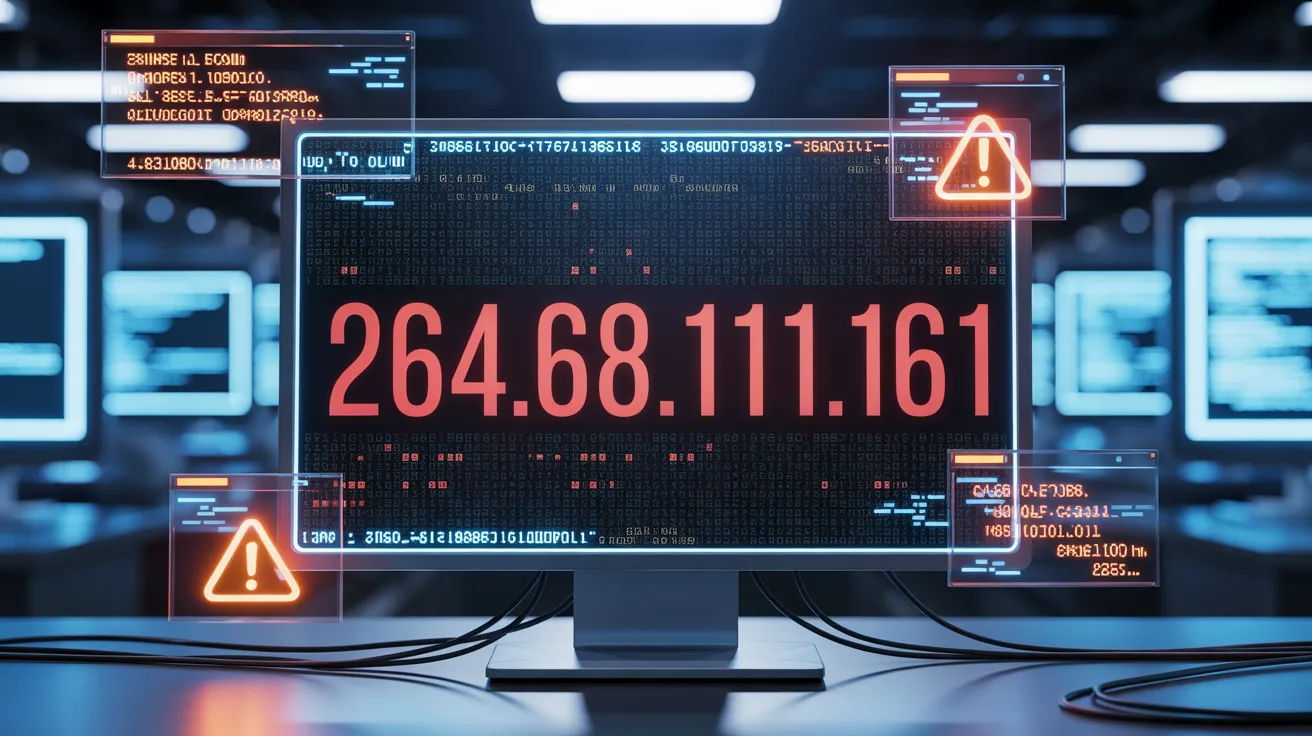
In the intricate web of digital networking, 264.68.111.161 stands out as a curious anomaly that sparks questions among tech enthusiasts and professionals alike. This sequence mimics the structure of an IP address but fails to meet the fundamental rules of internet protocol, rendering it invalid for practical use. Exploring 264.68.111.161 reveals insights into IP address mechanics, potential security implications, and its role in educational and testing environments. As we delve deeper, you’ll see how such anomalies contribute to a broader understanding of online connectivity and safety.
Understanding IP Addresses: The Basics
To appreciate why 264.68.111.161 is noteworthy, start with the fundamentals of IP addresses. These numerical labels identify devices on a network, enabling data to flow between them. The most common type, IPv4, consists of four octets separated by periods, each ranging from 0 to 255. This format allows for billions of unique combinations, but it’s strictly bounded to ensure efficient routing.
264.68.111.161 appears to follow this pattern at first glance, with four segments: 264, 68, 111, and 161. However, the first octet—264—exceeds the 255 limit, making the entire address unusable in standard networks. This violation disrupts the binary representation underlying IPs, where each octet is an 8-bit value (hence 0-255). In contrast, valid examples include 192.168.1.1 (a private network address) or 8.8.8.8 (Google’s DNS server). Recognizing these boundaries helps demystify why 264.68.111.161 doesn’t function as intended.
Beyond structure, IP addresses fall into classes: A (large networks), B (medium), C (small), D (multicast), and E (experimental). 264.68.111.161 doesn’t fit any, as its leading value places it outside defined ranges. This classification system, though somewhat outdated with modern CIDR notation, still informs how networks allocate addresses.
Why 264.68.111.161 Is Invalid: A Technical Breakdown
Diving into the specifics, the invalidity of 264.68.111.161 stems from IPv4’s design constraints. Each octet represents a byte, and bytes top out at 255 in decimal (11111111 in binary). A value like 264 would require more bits, which IPv4 doesn’t accommodate. Attempting to use 264.68.111.161 in a browser or ping command typically results in an error, as routers and systems reject it outright.
Consider the octet-by-octet analysis:
- First octet (264): Invalid; must be 0-255. This alone disqualifies the address.
- Second octet (68): Valid; within range.
- Third octet (111): Valid.
- Fourth octet (161): Valid.
This partial validity might confuse beginners, but the whole must comply. In networking tools, validation scripts often flag such addresses immediately. For instance, a simple Python check using socket libraries would return an error for 264.68.111.161. Understanding this helps in debugging network issues or verifying configurations.
Moreover, 264.68.111.161 highlights the transition to IPv6, which uses hexadecimal notation (e.g., 2001:db8::1) to expand the address space. While IPv4 shortages drive this shift, anomalies like 264.68.111.161 underscore the limitations of the older system.
Common Uses of Invalid IPs Like 264.68.111.161
Though unusable for real connections, 264.68.111.161 finds purpose in controlled settings. In educational contexts, instructors use it to teach IP validation, demonstrating how systems handle errors. Textbooks and online tutorials often cite similar examples to explain octet rules, helping students grasp networking basics.
In software testing, developers employ 264.68.111.161 as input for boundary checks. Applications must gracefully reject invalid data to prevent crashes or vulnerabilities. For example, firewalls or intrusion detection systems test against such addresses to ensure robust filtering. Honeypots—decoy systems to lure attackers—might log attempts involving 264.68.111.161, gathering intelligence on malicious behavior without risking actual networks.
Additionally, 264.68.111.161 appears in technical documentation as a placeholder. It avoids referencing real IPs that could lead to unintended traffic. This practice maintains privacy and prevents abuse, making 264.68.111.161 a safe choice for illustrations in blogs, forums, or code samples.
Potential Risks Associated with 264.68.111.161
While 264.68.111.161 itself isn’t inherently dangerous, its appearance can signal underlying issues. In server logs, it might indicate misconfigured software or attempted exploits, where attackers probe with invalid data to find weaknesses. Cybersecurity experts monitor for such anomalies, as they could precede more serious threats like DDoS attacks or data breaches.
In scams, fraudsters might embed 264.68.111.161 in phishing emails or spoofed websites to mimic legitimate sources. Users clicking links tied to invalid IPs risk malware infection or credential theft. Though the address can’t route traffic, it serves as a red flag—prompting vigilance. For instance, if an email claims a security alert from 264.68.111.161, it’s likely fake.
To mitigate risks, regularly review logs for unusual entries like 264.68.111.161. Implement validation in custom apps and use reputable tools for IP checks. Awareness of these patterns empowers users to stay secure in an increasingly connected world.
How to Validate and Handle Addresses Like 264.68.111.161
Validating IPs is straightforward with the right methods. Online tools or command-line utilities can quickly assess 264.68.111.161. For manual checks, confirm each octet is 0-255 and the format has exactly three dots.
In programming, libraries simplify this:
- Python: Use ipaddress module; attempting to parse 264.68.111.161 raises ValueError.
- JavaScript: Regex patterns like ^((25[0-5]|2[0-4][0-9]|[01]?[0-9][0-9]?).){3}(25[0-5]|2[0-4][0-9]|[01]?[0-9][0-9]?)$ would fail for it.
When encountering 264.68.111.161 in practice, document the context— was it in a log, email, or code? Isolate affected systems and scan for malware. For educational purposes, use it to train teams on error handling.
Here’s a comparison of valid vs. invalid IPs:
| IP Address | Validity | Reason |
|---|---|---|
| 192.168.1.1 | Valid | All octets 0-255 |
| 8.8.8.8 | Valid | Standard DNS example |
| 264.68.111.161 | Invalid | First octet > 255 |
| 10.0.0.256 | Invalid | Fourth octet > 255 |
| 300.1.2.3 | Invalid | First octet > 255 |
This table aids quick reference, emphasizing patterns to watch.
The Broader Implications of Invalid IPs in Networking
Invalid addresses like 264.68.111.161 play a subtle yet important role in the ecosystem. They expose gaps in protocol design, accelerating the adoption of IPv6, which offers vastly more addresses without octet limits. In forensics, tracking such anomalies helps trace attack origins or system flaws.
For businesses, understanding 264.68.111.161 informs better security policies. Regular audits catch invalid entries early, preventing escalation. In research, it serves as a case study for protocol evolution, inspiring improvements in future standards.
As networks grow, anomalies like 264.68.111.161 remind us of the need for robust validation at every layer.
Case Studies: Real-World Encounters with 264.68.111.161
Though fictional in function, 264.68.111.161 mirrors real scenarios. In one cybersecurity report, similar invalid IPs appeared in botnet scans, where automated tools tested ranges beyond 255 to exploit misconfigurations. Analysts used this to map attacker behaviors.
In software development, a team debugging a web app encountered 264.68.111.161 in user input fields. It revealed a validation flaw, leading to code fixes that enhanced overall security.
Educational platforms simulate 264.68.111.161 in quizzes, teaching students to identify errors. These cases show its practical value beyond mere curiosity.
Best Practices for IP Management
To avoid pitfalls related to addresses like 264.68.111.161, adopt proactive strategies. Use automated tools for continuous monitoring, flagging invalid entries instantly. Train staff on IP basics to foster a security-conscious culture.
In development, incorporate strict input sanitization. For networks, configure routers to drop invalid packets automatically. Regular updates to protocols ensure compatibility with evolving standards.
By following these, you minimize risks and maximize efficiency.
Future of IP Addressing and Anomalies
Looking ahead, as IPv6 dominates, anomalies like 264.68.111.161 may become relics. Yet, they inform hybrid systems bridging old and new tech. Emerging AI-driven networks could auto-correct such errors, enhancing reliability.
In education, 264.68.111.161 will continue as a teaching tool, evolving with curriculum updates.
Conclusion
264.68.111.161 exemplifies the precision required in digital networking, serving as a gateway to deeper technical knowledge. From its invalid structure to applications in testing and security, it offers valuable lessons for anyone navigating the online world. Embracing such insights strengthens our grasp on technology’s foundations, paving the way for safer, more efficient connections.